Backend Automation Services for Where
Workflow Tools Hit Their Ceiling
Barq Digital AI builds custom backend automation systems for companies whose volume, complexity, or business logic has outgrown what any no-code platform can handle. Custom Node.js and Python services, AI-powered worker pools, database pipelines, queue infrastructure, scheduled jobs, and microservices engineered to run reliably at scale, integrated with the rest of your stack, fully owned by your team.
n8n orchestrates. We build what it orchestrates. Production-grade backend automation, fixed-price, fully yours.
Your Automation Stack Hit the No-Code Ceiling Six Months Ago.
Everyone's Pretending It Didn't.
Every fast-growing company eventually meets the same wall.
The Zapier zap that worked at 500 records a day chokes at 50,000. The Make scenario times out on the data transformation that needs to run across 12M rows. The "send this to the team" workflow turns out to require business logic that no node in any platform can express. The data pipeline that powers the leadership dashboard runs nightly in a Notion + Sheets + spreadsheet macro chain that breaks every other Wednesday and nobody fully understands.
You have two bad options. Ship the engineering team at the problem and watch the product roadmap slip for six months. Or paper over it with another SaaS subscription, more zaps, another sync tool, another nightly script and watch the reliability slowly rot.
There's a third option: custom backend automation, engineered like real software, deployed in three weeks. That's what this page is about.
80% of organizations have automation deployed somewhere — but only 13% have it deployed at scale across multiple business units. The gap is almost always "the tool we picked doesn't handle our actual volume or logic."
Engineering teams at growth-stage companies spend 30–40% of their capacity on internal tooling and automation work that doesn't ship customer-facing features.
Where Workflow Tools End and
Backend Automation Begins
There's a clean line between workflow automation and backend automation, and most agencies blur it on purpose.
Workflow automation lives in tools like n8n, Make, and Zapier. It's visual, fast to build, and perfect for connecting SaaS apps for events that fire dozens to thousands of times per day. Stop being the right answer when you hit volume ceilings, complex transformations, custom logic, database-heavy work, or jobs that need to live as permanent infrastructure.
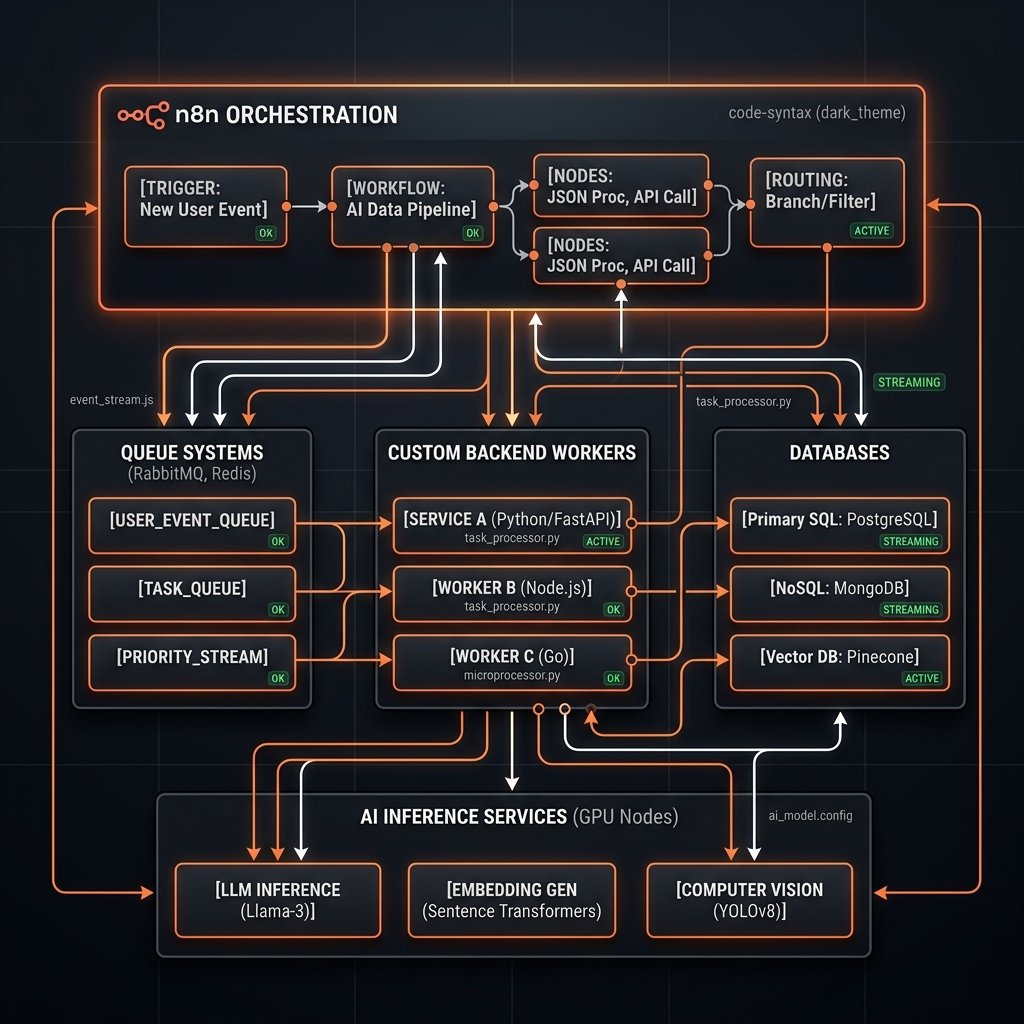
1. Service Layer
Node.js, Python, or Go services exposing internal APIs (REST or gRPC), built with proper error handling, structured logging, and dependency injection.
2. Queue Infrastructure
BullMQ, Celery, RabbitMQ, or SQS for async work. Workers consume jobs, retry on failure, push to dead-letter queues when retries exhaust.
3. Scheduled Jobs
Cron-style schedulers for batch work, with idempotency guarantees so re-runs don't double-process.
4. Database Layer
PostgreSQL, MongoDB, or Redis with proper indexing, migrations, connection pooling, and read-replica strategies for scale.
5. AI Worker Layer
When AI inference is part of the pipeline, dedicated workers handle LLM calls, manage rate limits, batch where it makes sense, and track cost per job.
6. Orchestration Layer
n8n (or your tool of choice) sits above the backend services, triggering them and reacting to their output. Workflow tool as the conductor; backend services as the orchestra.
7. Observability
Structured logs, distributed tracing, metric dashboards, and alerting on queue depth, worker health, and failure rates.
8. Deployment
Containerized (Docker), deployed to AWS, GCP, or your existing cloud, with infrastructure-as-code (Terraform or equivalent) so the whole system is reproducible.
What You Actually Gain From Backend Automation Built by Engineers
Volume and complexity ceilings disappear
Custom backend services scale horizontally with workers, queues, and proper database design. The 'we can't run this in Zapier because it'd cost $40K/month' problem goes away.
Your engineers go back to building products
When backend automation is owned by a specialist team, your in-house developers stop firefighting internal tooling and go back to features that differentiate. Median customers reclaims 30+ engineering hours per week within 60 days.
Custom business logic where no-code can't reach
When the automation needs to express logic that no platform node represents complex pricing rules, custom matching algorithms, multi-stage approval workflows with state machines, AI-powered classification with custom training backend code is the only honest answer.
Real reliability engineering by default
Idempotency, retries, dead-letter queues, circuit breakers, observability, alerting. The production-grade reliability patterns that no-code tools skip and that turn flaky automation into reliable infrastructure.
Database-heavy operations done right
ETL pipelines process tens of millions of rows. Real-time data synchronization across operational systems. Schema migrations that don't break production. Database automation services built by people who've actually shipped them.
AI workers that actually scale
AI-powered backend automation LLM workers with proper batching, streaming, fallback chains, cost monitoring, and rate-limit handling. AI agents backend integration that runs as production infrastructure, not as Postman experiments wrapped in cron.
No platform lock-in
Code in your GitHub. Infrastructure in your cloud. Database under your control. Documentation in your wiki. If you ever leave us, any competent engineer can take over. That's the opposite of how iPaaS and most SaaS-tool consultancies operate.
Fixed-price builds, not hourly billing
We scope the build, give you a fixed price, and ship it in 21 days. No surprise invoices. No 'discovery phase' that bills hours indefinitely.
Inside the Backend Capabilities We Build
Node.js, Python, and Go Services
Node.js automation services for high-concurrency I/O work. Python automation services for data, ML, and AI pipelines. Go where raw performance matters. Server-side automation that fits your team's existing stack.
Queue-based worker systems
BullMQ (Node), Celery (Python), RabbitMQ, AWS SQS, or Google Cloud Tasks. Background workers consuming jobs from queues, with proper retry logic, exponential backoff, and dead-letter handling. Automated task processing at scale.
Scheduled job systems
Cron-style schedulers running batch jobs, ETLs, reports, and scheduled AI work with idempotency, observability, and failure recovery built in. Automated reporting systems that don't break silently.
Database automation services
PostgreSQL, MongoDB, Redis, MySQL, Supabase. Schema design, migration strategy, indexing optimization, connection pooling, read replicas, change-data-capture (CDC), and real-time data synchronization. SQL automation services, MongoDB automation, automated database workflows are all production-hardened.
AI worker pools
Dedicated services for LLM inference (OpenAI, Anthropic, open-source models), with proper batching, streaming response handling, cost-per-job tracking, fallback chains, and rate-limit management. AI infrastructure automation as production code.
Custom data pipelines
Data pipeline automation across operational systems, warehouses (Snowflake, BigQuery, Redshift), and analytics tools. Stream processing where real-time matters, batch where it doesn't. Data processing automation built for scale.
Microservices automation
When the right answer is breaking the system into discrete services — order processing, billing, notifications, inference we design and ship microservices automation with proper service boundaries, API contracts, and observability.
Custom admin tools
Internal dashboards, ops consoles, approval interfaces, and admin panels built fast on Next.js/React + your backend, with proper auth, RBAC, and audit logging. Internal process automation as actual software, not a Notion database with permissions.
n8n + custom code hybrids
n8n workflow automation services for the orchestration layer. Custom backend services for the heavy lifting. Together, they cover the full range of automation work the right tool for the right job, not 'everything is a nail' thinking. Custom n8n automation development is one of our most-requested patterns.
API workflow automation
REST API automation, webhook automation services, custom middleware automation, third-party API integrations, and custom API workflows where the backend logic doesn't fit into a workflow node.
Cloud-native deployment
Docker containers, AWS / GCP / Azure, infrastructure-as-code (Terraform), CI/CD pipelines, monitoring (Datadog, New Relic, Grafana), and alerting. Cloud automation solutions deployed the way real engineering teams deploy.
Dedicated Worker Pools?
We architect highly cost-effective self-hosted workers on VPS or bare-metal setups to process high throughput workloads without the premium license markups.
Who This Is
Built For
We deploy custom-architected backend solutions mapped precisely to your transactional loads and system structures.
Custom Order & Transaction Processing backends
eCommerce, marketplaces, booking platforms. Backend services handling order ingestion, validation, fraud-checking, inventory sync, and fulfillment routing at scale.
How Barq Designs and Ships Your Backend System in 21 Days
Discovery & Architecture Audit
We map your existing systems, identify the automations that warrant real backend work (and the ones that should stay in n8n or Zapier), and review your scaling, security, and compliance constraints. You leave Day 3 with a clear architecture and a build prioritization ranked by ROI and risk.
System Design & Contract Definition
We design the backend system: service boundaries, API contracts, queue topology, database schema, worker patterns, observability hooks, and deployment topology. For multi-service systems, we publish internal API specs before writing a line of production code.
Build & Implementation
We build in the right language (Node.js, Python, Go) and the right framework (Express/Fastify/NestJS, FastAPI/Django, Gin). Queues, workers, schedulers, and database layers all engineered with reliability patterns baked in not retrofitted. n8n integration where workflow orchestration is the right tool.
Testing & Reliability Hardening
Unit tests on business logic, integration tests against real dependencies, load tests at 2x expected production volume, and chaos tests against failure modes (queue backed up, database connection lost, downstream API timing out). We don't ship until failure modes are predictable.
Deployment & Monitoring
Containerized and deployed via CI/CD to your cloud (AWS, GCP, Azure) or ours, with infrastructure-as-code so the deployment is reproducible. Monitoring, logging, and alerting wired into your existing observability stack (Datadog, New Relic, Grafana, or our recommended setup).
Handover & Live Training
You get the codebase (in your GitHub or GitLab), Terraform files, OpenAPI specs, runbooks for common failure modes, observability dashboards, and a recorded technical walkthrough. Your engineering team gets a live handover session.
Retainer & Optimization
SLA-backed monitoring, incident response, performance optimization, vendor-API-change adaptation, and new backend builds available as a retainer for teams that want a senior backend partner without full-time hiring.
Custom Backend Automation Agency vs. Alternatives
Wondering which option fits your scale and team? Here is the honest landscape.
| Capability | In-House Engineering | No-Code-Only Shops | iPaaS (Workato, Boomi) | Barq Custom Build |
|---|---|---|---|---|
| Time to live | 8–16 weeks | 1–3 weeks (limited scope) | 6–12 weeks | 3 weeks |
| Cost | $150K–$300K/eng-year | $5K–$25K (capped scope) | $40K–$300K/yr platform | Fixed-price build |
| Handles volume/complex logic | Yes (slow) | No | Limited (their DSL) | Yes, custom code |
| Uses n8n where it fits | Rarely | Only option | No | Yes, when it's right |
| AI inference pipelines | Varies | No | Add-on tier | Native, first-class |
| Database design & migrations | Yes | No | Limited | Yes, real DB engineering |
| Production reliability | Varies | Skipped | Yes | Standard |
| Handover & ownership | N/A | Limited | Their platform required | Full codebase + IaC + runbooks |
See What Backend Automation Would Save You
In 60 Seconds
Most clients recover the build cost within 60–90 days from engineering capacity reclaimed and SaaS-subscription consolidation. Our automation ROI calculator built from real project data models your specific economics. No email required to see the results.
Backend Automation ROI Calculator
Proprietary Engineering Impact Model
Real Deployments, Real Numbers
"We were about to hire two backend engineers to build internal tooling. Barq shipped the entire backend automation system in three weeks for less than one engineer's first quarter. Six months in, it's still running with zero incidents."
"Our order processing was held together with Zapier and prayer. Barq replaced it with a custom Node.js backend on AWS — queues, workers, the works. We process 4x the daily order volume now and our on-call rotation went quiet."
Consolidating Fragile stacks into Custom Celery Pipeline
A B2B SaaS company hired Barq to replace their fragile multi-tool data enrichment stack with a custom backend pipeline. We built Python workers on Celery + PostgreSQL processing 8M+ contact records per day with AI-powered classification, deduplication, and CRM sync. Replaced 4 SaaS subscriptions, eliminated 30+ engineering hours per week of babysitting work, and dropped end-to-end pipeline latency from 14 hours to 22 minutes.
Read the full case studyFrequently Asked Questions
Stop Outgrowing Your Automation Stack Every 6 Months.
Build the Backend Once, Properly.
The best backend automation company isn't the one selling you another SaaS subscription. It's the one that ships production-grade custom code workers, queues, databases, AI pipelines, admin tools engineered to scale with your business and owned outright by your team. n8n where it fits. Real code where it matters.
30-minute call. No pitch. We'll audit your current stack, map where no-code is hitting a ceiling, model the engineering capacity you'd reclaim, and tell you whether we're the right fit. If we're not, we'll point you to who is.