API Integration Services Built Like Production Code —
Not Like a Weekend Zap
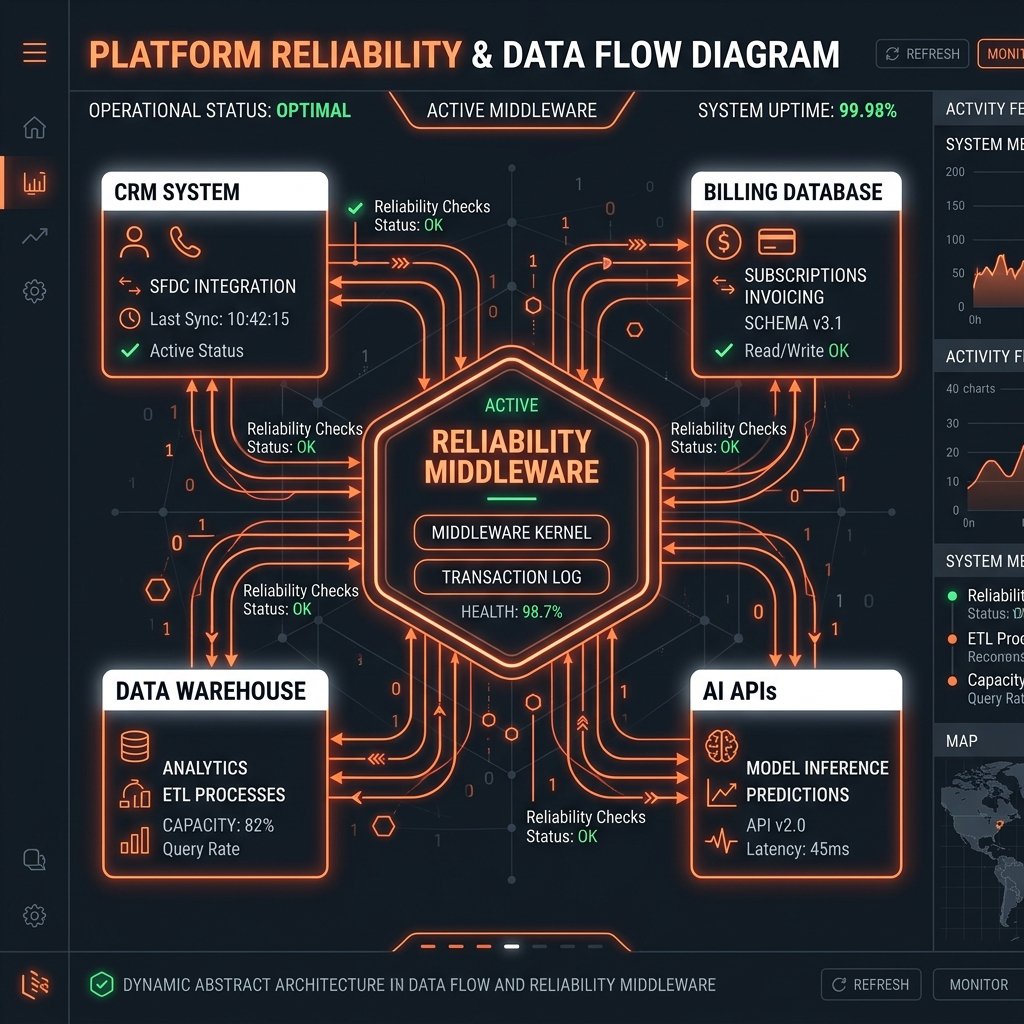
Barq Digital AI builds custom API integrations for companies whose stack has outgrown no-code shortcuts. We engineer the connective tissue between your CRM, ERP, billing, data warehouse, AI APIs, and any system with an endpoint with proper authentication, idempotency, retries, observability, and security. No-code where it fits. Real code where it matters.
REST, GraphQL, webhooks, middleware, real-time data sync, AI API orchestration. Built on n8n, Make, Pipedream, and custom Node.js/Python backends when the job demands it.
Your "Integrated" Stack Isn't Integrated.
It's Held Together With Cron Jobs and Hope.
Take an honest look at the connective tissue of your business.
Stripe charges a customer. HubSpot doesn't update for 6 hours because the webhook lives in a Zap that times out 4% of the time. The data warehouse runs a nightly sync that breaks silently every other Tuesday. Finance opens a ticket because the revenue numbers don't reconcile again. Your engineering team spends 18 hours a sprint babysitting integrations that should have been "set it and forget it" two years ago.
The no-code instinct ("we'll Zap it") works until the volume scales past Zapier's tier, the transformation logic gets complex, or the vendor changes their API and your zap silently breaks for three weeks before anyone notices. Then you do what every growing company does: you ship an engineer to "fix the integration" and they fix it for six months. That engineer should have been building the product.
You don't need another zap. You need production-grade API integration services code that handles auth properly, retries intelligently, alerts you when something breaks, and stays out of your way while doing it.
of cloud services and applications are actually integrated across the average enterprise.
is spent by developers on integration work — writing code that doesn't ship core features and doesn't differentiate the product.
What "Production-Grade API Integration"
Actually Requires
Most developers focus on the happy path. But in production systems, the happy path only happens 95% of the time. The other 5% is where data corruption and silent errors cost businesses hundreds of thousands of dollars.
Production-grade integrations require a resilience blueprint:
1. Schema Validation
Every payload undergoes structural checks on ingestion. If an API provider changes its structure, we fail loud and prevent corrupt database states.
2. Secure Credentials
We implement OAuth 2.0 flows, JWT validation, short-lived tokens, HMAC signatures, and secure vaults. No API keys ever sit plain-text in code files.
3. Protocol Bridging
System A outputs JSON; System B consumes SOAP. We build highly efficient data mapping pipelines that translate, sanitize, and normalize structures.
4. Event Buffering
High volumes require buffer queues. Redis, SQS, or BullMQ handle spike traffic securely, preventing downstream database lockouts.
5. Idempotent Retries
If System B drops for 30s, we auto-retry with exponential backoff. Idempotency guarantees that retried charges or orders never trigger duplicates.
6. Dead Letter Queue
When messages fail permanently, they route to a Dead Letter Queue (DLQ) for manual inspection, preserving logs and context for recovery.
7. Observability
We install metrics dashboards and OpenTelemetry tracing to track error rates, latency, p99 speeds, and downstream third-party availability.
8. Version Guardrails
We build with version-locking frameworks, enabling updates to endpoints without breaking legacy client applications.
What You Gain From Production API Integrations
Your engineers stop being plumbers
When integration work is owned by a specialist team, your in-house developers go back to building products. We've seen teams reclaim 30%+ of engineering capacity inside the first 90 days.
Real-time data sync that works
No more 'the dashboard is wrong, refresh in 4 hours.' Real-time data synchronization across CRM, billing, data warehouse, support, and product analytics with sub-second latency.
Integrate with resilience to change
Schema validation, versioning strategy, and observability mean when Stripe ships a breaking change or HubSpot deprecates an endpoint, your alert fires before downstream systems fail.
Scale without rebuilding
Custom integrations engineered for 100x your current volume proper queues, async patterns, batch processing where it fits, and stream processing where real-time is required.
99.97%+ uptime on integrations
That's our actual measured number across deployed clients. The difference between 99.5% and 99.97% is the difference between a daily fire drill and a quarterly check-in.
No vendor lock-in
We build on open standards and hand you the codebase, the documentation, the infrastructure-as-code, and the credentials. If you ever leave us, the system keeps running.
AI APIs as first-class citizens
OpenAI, Anthropic, Google, and open-source LLM endpoints orchestrated with proper error handling, fallback chains, cost tracking, and prompt versioning.
Honest about when no-code wins
For 60% of integration jobs, the right answer is n8n or Make. We tell you that on day one and save you money instead of selling you a custom build you didn't need.
Inside the API Capabilities We Engineer
REST and GraphQL API integration
REST API development services, REST API integration, and GraphQL API development across modern SaaS, legacy systems, and custom backends. Schema-validated, type-safe.
Custom API development
When you need your own API for partners, mobile apps, or internal consumers. Deployed on Node.js, Python, or Go, on AWS, GCP, or your infrastructure.
Webhook automation services
Inbound webhook handlers with HMAC signature verification, replay protection, and queue-based processing. Outbound webhook orchestration with retry logic.
API middleware development
When System A and System B don't speak the same language. Data transformation, schema mapping, state management, and protocol bridging.
AI API integration services
OpenAI, Anthropic, Google, Cohere, and open-source LLM endpoints. Streaming responses, prompt versioning, token tracking, fallback model chains.
CRM API integration
HubSpot API integration, GoHighLevel API integration, Salesforce API integration, Zoho CRM integration, Pipedrive, Close. Bi-directional sync with conflict resolution.
Database API integration
PostgreSQL, MongoDB, MySQL, Redis, Supabase, Firestore, and DynamoDB. Custom data pipelines, change-data-capture (CDC), and real-time replication.
Data sync & migration
API data migration services for replatforming, automated data sync solutions across distributed systems, and custom data pipelines built for scale.
Workflow orchestration
n8n API integrations (our core), Zapier, Make, and Pipedream integrations picked per job based on volume, complexity, and cost economics.
API security solutions
OAuth 2.0 flows, JWT validation, API key rotation, IP allowlisting, rate limiting, request signing, and secrets management.
API documentation services
OpenAPI/Swagger specs, Postman collections, internal developer portals, and code samples so your team can actually use what we build.
Observability & monitoring
Structured logging, distributed tracing (OpenTelemetry), metric dashboards (Grafana), and alerting on failure rates, latency, and anomalies.
Custom Database Connections?
Our architects design PostgreSQL, MongoDB, Redis, and Supabase database integrations, sync pipelines, and change-data-capture (CDC) structures.
Who This Is
Designed For
We deploy custom-architected integration systems mapped precisely to your architectural requirements, workflows, and industry vertical.
SaaS-to-SaaS Integration Services
Stripe ↔ HubSpot ↔ data warehouse, Shopify ↔ ERP ↔ 3PL, Zendesk ↔ Salesforce ↔ Slack, real-time CRM-to-marketing-platform sync. We connect your software systems directly with real-time sync.
How Barq Deploys Custom APIs in 21 Days
Discovery & Systems Audit
We map your existing stack, audit current integrations (and failure modes), and review documentation for every system in scope.
Architecture & Contract Design
We design the integration architecture: data flow diagrams, schema contracts, auth strategy, and publish OpenAPI specs.
Build & Implementation
We build workflows in n8n/Make or custom middleware (Node.js/Python). Idempotency, retries, and validation are built-in.
Testing & Hardening
Unit tests, integration tests against vendor sandboxes, chaos testing, and load testing. We don't ship until failure modes are predictable.
Soft Launch & Parallel Run
We launch with a percentage of live traffic, monitor every API call, alert on anomalies, and tune until metrics hold.
Handover & Documentation
You get the codebase, IaC, OpenAPI specs, Postman collections, runbooks, observability dashboards, and a live training walkthrough.
API-Native Agency vs. Alternatives
Wondering where to outsource your API integrations? Here is how Barq stacks up against generalist developers, DIY no-code tools, and enterprise iPaaS systems (e.g. Workato, Boomi).
| Capability | In-House Engineers | DIY No-Code (Zapier) | Enterprise iPaaS | Barq Build |
|---|---|---|---|---|
| Time to Production Sync | 3–6 Months | Days (unstable) | 2–3 Months | 21 Days |
| Codebase Ownership | 100% Yours | Vendor locked | Vendor locked | 100% Yours (Git / IaC) |
| Idempotency & Retries | Custom setup | Basic / None | Configurable | Standard on every sync |
| Uptime Service Agreement | None (Internal priority) | None | 99.9% | 99.97% Measured Uptime |
| Monthly Software Cost | $0 | $500+ (High volume) | $2,000+ | Open-source options (n8n/Node) |
| Observability & Monitoring | Manual setup | Basic alerts only | Standard dashboards | OpenTelemetry + failure alerts |
* Note: In-house teams are best if custom integrations represent your core product value. For operational syncs, outsourcing to specialists saves engineering time.
Calculate the Operational Impact of
Custom API Integration In 60 Seconds
Most clients recover their investment within 45 days from eliminated maintenance hours and prevented data failures. Calculate your metrics with zero email registration required.
Integration ROI Calculator
Proprietary Operations Impact Model
Real Deployments, Real Reliability
"Our internal developers were spending 15 hours a week debugging webhooks between HubSpot and Stripe. Barq replaced it with a middleware running on n8n that has run for 6 months without a single duplicate charge."
"We tried using Zapier for order syncs into our ERP, but high volume hit cost limits and timed out daily. Barq built a queue-based middleware on Node that handles 100k daily records with zero lag."
How a Series-B SaaS Reduced Billing Errors by 94%
A growing SaaS team was losing hours weekly manually correcting Stripe invoice errors and database state mismatches. Barq engineered a middleware connection that handles real-time synchronization, auto-retries, and event logging. In the first 90 days, billing errors fell by 94%, recovering 22 hours of core developer time weekly.
Read the full integration case studyFrequently Asked Questions
Stop Patching Leaks.
Build Integration Middleware That Lasts.
We design, test, deploy, and maintain custom API integrations and middlewares. No-code where it saves you licensing money; custom node/python code where volume, security, or data rules require it. Delivered in 21 days.
30-minute system discovery call. No hard pitch. We will map your current endpoints, diagnose failure points, suggest the cheapest setup, and tell you if we are not the right fit.